If you’re ambitious but lazy, watch this
Key Takeaway
To overcome the gap between ambition and laziness, one must define specific emotional drivers, identify and eliminate internal blockers, and strictly protect time for those goals in their calendar.
Highlights
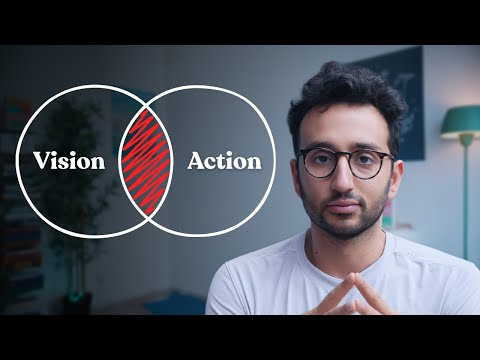
The Productivity Matrix categorizes individuals based on the axes of Vision (ambition) and Action (execution).
Transitioning from a 'Dreamer' to a 'Master' requires shifting from vague 'should' motivation to compelling 'pull' motivation.
Goal definition must include specific parameters and a deep, emotionally-driven 'why' to sustain long-term drive.
The Trichotomy of Control helps identify blockers by categorizing them into things we control, things we don't, and things we somewhat control.
Productivity masters excel at 'ignoring and outperforming' systemic obstacles while actively removing solvable internal blockers.
The 'Time Block Method' is the most effective practical tool for ensuring that priorities are reflected in one's actual schedule.
Timeline
The Productivity Matrix: Vision vs. Action
Ali introduces a framework called the Productivity Matrix, which evaluates individuals based on two primary axes: Vision and Action. He identifies four distinct personas: Drifters, who lack both goals and effort; Dreamers, who have high ambition but low execution; Hamsters, who work hard without a clear direction; and Masters, who combine a compelling vision with consistent action. This section highlights that the 'Dreamer' category is the primary focus for those who feel ambitious but struggle with laziness. By understanding these quadrants, viewers can diagnose their current state and identify the shift required to reach mastery. The ultimate goal is to move from simply dreaming to becoming a productive Master through a structured three-step process.
Step 1: Clarifying the 'What' and the 'Why'
The first step in the transformation process involves moving beyond vague desires like 'being rich' toward specific, parameterized goals. Ali emphasizes the difference between 'push' motivation, where you force yourself to do things you feel you 'should' do, and 'pull' motivation, where an intrinsic desire naturally draws you forward. He explains that emotional reasons are significantly more powerful than logical reasons when it comes to maintaining long-term discipline. By writing down specific reasons for a goal, an individual can create a more resilient drive that withstands the inevitable ebbs and flows of motivation. The speaker warns that 'should' motivation often stems from external pressure, such as parental expectations, and rarely leads to sustainable success for the ambitious but lazy.
Educational Sponsor and Learning Fundamentals
During this segment, Ali discusses the importance of foundational knowledge in modern fields like Artificial Intelligence and computer science. He promotes Brilliant, an online education platform, noting its effectiveness in teaching through problem-solving rather than passive, didactic learning. The section highlights that learning is most effective when it is interactive and requires the immediate application of new concepts. Ali shares his personal experience using the platform for topics ranging from Python programming to cryptocurrency. He concludes by offering a free trial and discount to his audience, reinforcing the idea that continuous learning is a key component of the entrepreneurial journey.
Emotional Drive: Learning from Personal Experience
Ali shares a personal anecdote from his time as a medical doctor to illustrate the power of emotionally compelling reasons. He observed older colleagues who were miserable and felt trapped by their financial obligations, which created a visceral fear of following the same path. This feeling became a powerful 'pull' motivation for him to build a lifestyle business and achieve financial freedom. He notes that without this strong emotional anchor, starting a business would have remained a 'should' rather than a necessity. The core message here is that identifying what you truly want to avoid can be just as motivating as what you want to achieve. This deep clarity serves as the engine that powers the transition from lazy dreamer to active master.
Step 2: Identifying and Removing Blockers
The second step focuses on identifying the specific obstacles that prevent someone from reaching their goals. Ali introduces the 'Trichotomy of Control,' which separates blockers into those within our control, those outside of it, and those where we have partial influence. He argues that high-level achievers and CEOs excel specifically because they are masters at 'identifying and removing blockers.' For systemic issues outside of one's control, such as government policy or physical height in sports, the advice is to 'ignore and outperform' or change the goal entirely to avoid a lifetime of misery. This section challenges the viewer to stop using external factors as excuses and instead focus on solvable problems like finding business ideas or learning sales techniques. Investigating solutions for internal blockers is presented as a primary skill for anyone seeking financial or creative freedom.
Step 3: The Time Block Method and Accountability
The final step addresses the most common excuse for lack of action: a perceived lack of time. Ali asserts that the single biggest difference between people who do things and those who don't is the use of time blocks in a calendar. He describes how his 'Lifestyle Business Academy' forces students to send screenshots of their blocked-out time to ensure accountability. By creating a 'container of time' for work, individuals remove the need for constant discipline and make their priorities tangible. He shares examples of friends and students who achieved significant financial success simply by protecting specific hours each week for their side hustles. The video concludes with an invitation to use a '168 hours spreadsheet' to audit and reclaim one's time for meaningful projects.
Description
Visit https://brilliant.org/aliabdaal to start your free 30-day trial and get 20% off an annual subscription. Join Lifestyle Business Academy: https://go.lifestylebusiness.com/ytdambitious --- MY PRODUCTIVITY APPS 📝 Momentum: Energising Habits (iOS) - Download Here → https://go.sparkle.so/momentum/ytd 👻 Voicepal: AI Writing App (iOS/Android) - Download for Free → https://go.aliabdaal.com/voicepal/ytd MY BOOK 📕 My New York Times bestselling book Feel-Good Productivity (2,000+ 5-star reviews) → https://go.feelgoodproductivity.com/amazon/yt MY COURSES 🚀 Build a $100k/year lifestyle business without quitting your day job → https://go.aliabdaal.com/lifestylebusinessytd 🧠 My Productivity System: LifeOS → https://go.aliabdaal.com/lifeos/ytd 🤑 Grow / Monetise your YouTube Channel → https://go.aliabdaal.com/PTYA/yt CONNECT WITH ME 💌 Join LifeNotes, my weekly email where I share what I’m reading & learning: https://go.aliabdaal.com/lifenotes/yt 📸 Instagram: https://instagram.com/aliabdaal 📱 TikTok: https://www.tiktok.com/@aliabdaal 👨💻 Linkedin: https://www.linkedin.com/in/ali-abdaal/ 🌍 My website / blog: https://www.aliabdaal.com/ --- Hey friends, if you feel like you’ve got big goals but you’re not actually taking action, this video is for you. I’ll show you my “productivity matrix” (drifters, dreamers, hamsters, masters) and walk you through a simple 3-step process to go from dreaming to doing: clarify what you actually want, identify and remove the blockers, and then time-block it in your calendar. Hope you enjoy xx 🔗 LINKS MENTIONED IN THIS VIDEO 📗 Discipline Equals Freedom by Jocko Willink: https://geni.us/k99PK 📘 $100M Leads by Alex Hormozi: https://geni.us/ZJRFFq ⌚️ TIMESTAMPS 00:00 Introduction 01:48 Step 1: Clarify What You Actually Want 09:30 Step 2: Identify the Blockers 18:24 Step 3: Make the Time to Do the Work PS: I donate 10% of my income to charity every year. Would you like to join me? Learn more about the 10% Pledge: https://aliabdaal.com/giving-what-we-can/