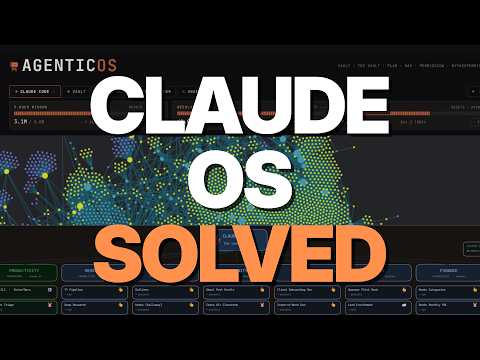
Your Claude Code Agentic OS Sucks
핵심 요약
An effective agentic operating system prioritizes a codified skill backbone and organized markdown memory layer over aesthetic dashboards to transform Claude Code from a basic chat interface into a deterministic automation engine.
하이라이트
A functional agentic OS consists of three distinct layers: a skill and automation backbone, a memory layer for context engineering, and an observability dashboard.
Codifying daily tasks into specific skills reduces the inherent randomness of non-deterministic Large Language Models to produce more reliable results.
The Content Cascade skill automates YouTube repurposing by downloading transcripts, generating blog and social posts, and executing the final publishing via Playwright.
Obsidian serves as an 80% effective memory solution by using index files in every subfolder to create a navigable table of contents for the AI.
Anthropic provides $200 in credits for headless Claude Code runs, but users can refactor the system to use the Codex CLI to avoid potential usage limits.
Streamlit web applications offer a superior distribution model for non-technical clients, while Obsidian dashboards prioritize ergonomic efficiency for solo operators.
타임라인
The Three-Layer Architecture of an Agentic OS
Most users focus on visually impressive command centers rather than the underlying automation infrastructure. A robust system requires turning repetitive workflows into specific skills that ensure consistent outputs. This foundation allows the AI to move beyond simple chat interactions and become a reliable execution environment.
- The skill and automation backbone is the primary driver of value in a Claude Code system.
- Obsidian acts as a memory layer that handles context engineering requirements for the majority of users.
- Dashboards provide visibility and command execution but only function effectively once the backbone is established.
Codifying Workflows into Deterministic Skills
Large Language Models are inherently non-deterministic, but creating specific skills forces them toward more predictable behavior. Users can identify these skills by narrating their daily routines to the terminal and asking the AI to pull out and benchmark specific automations. Higher-order skills like the Content Cascade demonstrate this power by executing transcript downloads and social media posting through a single trigger.
- Codifying tasks into skills enables rigorous benchmarking and A/B testing against standard manual prompts.
- Workflow skills combine multiple individual tasks into a single command to boost productivity.
- The Content Cascade skill manages the full lifecycle of YouTube content repurposing across LinkedIn, Twitter, and blogs.
The Triage Process and Customization
Customization is the core strength of Claude Code, yet many users settle for generic repositories instead of building tools for their specific domains. Basic productivity can be enhanced in 30 seconds by connecting the Gmail MCP, which allows for drafting emails and managing calendars directly from the terminal. Distinguishing between local and cloud automations is vital, as local execution ensures the agent has access to the user's specific development environment.
- Skill triage involves identifying domain-specific tasks and converting them into executable code via a skill creator prompt.
- Standard Model Context Protocol (MCP) connectors for Gmail and Google Drive provide a fast productivity boost without complex custom code.
- Local automations are preferred over cloud-based ones because they retain access to local files, CLIs, and system skills.
Memory Organization and the Index File System
Token efficiency improves when Claude Code can navigate a file system logically rather than searching through thousands of unorganized documents. By placing an index file in every subfolder, the user creates a path for the agent to 'snake' through the directory to find relevant context. This hierarchy transitions unstructured research into formal wikis and eventually into completed project deliverables.
- Obsidian provides a human-readable organization layer rather than a technical RAG or vector database solution.
- Master index files at every folder level act as a table of contents to guide the AI through large document sets.
- Effective file structures use subfolders for raw data, wikis for processed reports, and outputs for final deliverables.
Dashboard Selection: Streamlit vs. Obsidian
Choosing a dashboard depends on whether the goal is product distribution or personal productivity. Streamlit allows for easy deployment via GitHub, providing a simple interface with buttons mapped to complex backend skills. Obsidian's power lies in its infinite customizability, allowing users to build panels for audience metrics and trending GitHub repos alongside their active terminal sessions.
- Streamlit web apps are the optimal choice for distributing agentic tools to non-technical clients or teams.
- The Obsidian dashboard offers superior ergonomics for solo operators by integrating the terminal and file explorer into one view.
- Custom plugins allow Obsidian users to embed live Google Calendars and research feeds directly into their workspace.
Managing API Costs and Engine Refactoring
While concerns exist regarding the cost of headless automation, most users will not exceed the current credit allocations provided by Anthropic. If usage becomes a bottleneck, the system's modular design allows it to be redirected to the Codex CLI. This flexibility ensures that the investment in skill architecture remains valuable regardless of which AI model is driving the execution.
- Headless Claude Code runs are managed through API costs, though Anthropic currently offers $200 in monthly credits.
- The agentic OS chassis allows for swapping the underlying engine from Claude to Codex CLI in minutes.
- Refactoring the dashboard to point toward the Codex CLI ensures continued operation if API usage limits are reached.
설명
⚡Master Claude Code + Codex⚡ https://www.skool.com/chase-ai 🔥FREE community🔥 https://www.skool.com/chase-ai-community 💻 Need custom work? Book a consult 💻 https://chaseai.io Let's solve Claude Code Agentic OS. While the command center gets all the attention, the true power of an agentic OS is the skill architecture that acts as its backbone. In this video, I break down why that is, how to create it, and where we get the most value out of these complex systems. ⏰TIMESTAMPS: 0:00 - The Real Power 3:35 - Creating the Backbone 10:42 - What's the Point of Obsidian 13:53 - The Command Center 17:30 - The Landscape RESOURCES FROM THIS VIDEO: ➡️ Get all the prompts: https://www.skool.com/chase-ai ➡️ My Website: https://www.chaseai.io #claudecode