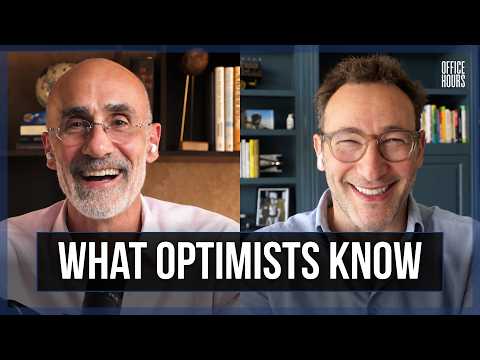
How to Be More Optimistic with Simon Sinek
핵심 요약
Practical optimism requires replacing passive hope with an actionable 4-step framework: consuming positive inputs, articulating a clear shared vision, anchoring that vision in an emotional story, and executing an adaptable plan written in pencil.
하이라이트
Toxic positivity denies reality, whereas genuine optimism accepts darkness while maintaining the conviction that people can reach the light at the end of the tunnel together.
Hope functions as passive waiting for outside events to change, while optimism requires vision and personal agency.
Finite mindsets tied to arbitrary deadlines cause burnout, whereas infinite mindsets sustain people through moving goalposts and prolonged hardship.
Negative narratives about colleagues or partners become self-fulfilling prophecies unless groups deliberately intervene to offer grace and alternative explanations.
Vision needs a specific emotional story illustrating why all the sacrifice, heartache, and setbacks remain worthwhile.
The 4-step framework for personal optimism requires actively consuming positive voices, defining a vivid future state, anchoring that vision in an emotional story, and executing an adaptable plan written in pencil.
타임라인
Defining Identity by Character Rather Than Past Accomplishments
Relying on job titles or awards creates vulnerability when those roles disappear. Focusing identity on enduring qualities such as being an optimist provides a permanent foundation that outlasts any single career milestone.
- Professional titles and past achievements become less relevant over time and leave an identity void once jobs end.
- Defining oneself by fundamental character traits ensures an enduring identity regardless of external career changes.
Optimism versus Toxic Positivity and the Role of Community
Denying problems creates severe risks in both business and personal environments. Enduring difficult circumstances requires community and a timeline broad enough to outlast immediate suffering. Every founder of the American women's suffrage movement died before the first woman voted, yet their persistent work built momentum that survived them.
- Toxic positivity denies difficult realities, while genuine optimism confronts hardship with the conviction that mutual support enables progress.
- Optimism requires relational support and gratitude because sheer individual grit eventually collapses under exhaustion.
- A long-term perspective enables individuals to labor toward outcomes that may only materialize beyond their own lifetimes, much like early suffrage leaders.
Optimism as Agency Versus Hope as Passive Waiting
Passive hoping resembles buying a lottery ticket and waiting for external circumstance to improve. Genuine optimism pairs a clear vision with active personal responsibility. Complaining about political or organizational issues without participating forfeits the right to voice grievance.
- The linguistic framing of hope often mirrors passive waiting without personal agency, while optimism demands active participation.
- Earning the right to complain requires contributing at least minimal effort toward solving the issue.
- Core optimism hinges on three elements: believing in a better future, knowing it is achievable, and actively participating in creating it.
The Stockdale Paradox and the Infinite Mindset
Prisoners of war who pinned their hopes on specific dates like Thanksgiving or Easter suffered fatal heartbreak when those dates came and went. Political prisoners endure years of solitary confinement only by abandoning rigid timelines in favor of an infinite mindset. Companies face identical morale collapses when they substitute shifting numerical targets for an enduring reason for being.
- Tying survival or motivation to rigid, arbitrary deadlines destroys morale when those deadlines pass.
- The Stockdale paradox demonstrates that enduring trauma requires absolute certainty of ultimate triumph paired with acceptance of an unknown timeline.
- Organizations that treat moving year-end goals as their ultimate purpose alienate workers through finite thinking.
Managing Expectations and Disrupting Destructive Narratives
Expectations must be explicitly communicated rather than assumed, as mind-reading fantasies breed resentment. In workplaces, attaching a derogatory label to a team member causes leadership to actively hunt for flaws until the employee is pushed out. Establishing a protocol where team members pause discussions to consider external factors, lack of direction, or burnout protects individuals from unfair stereotyping.
- Relationship fractures frequently stem from the unvoiced fantasy that others can read minds rather than outright malicious intent.
- Negative workplace labels like 'lazy Dave' create confirmation bias that ruins team performance.
- Active team intervention and grace prevent destructive labels from hardening into unfair organizational narratives.
Commercialized Fear and the Decline of Societal Optimism
Negative framing thrives because commercial business models reward content that triggers base survival instincts. Tech companies inflate automation capabilities to disguise corporate bloat, masking basic staffing errors behind futuristic hype. These incentives drain collective optimism by removing individual responsibility and blaming external enemies for personal problems.
- Pessimism and alarmist messaging generate higher ad revenue, clicks, and fundraising dollars than positive messages.
- Tech leaders use fear-based narratives, such as attributing mass layoffs to automated tools rather than overhiring, to maintain high market valuations.
- Social media algorithms exploit biological paranoia by prioritizing outrage and victimhood over personal agency.
Visionary Leadership and Cultivating White Space
Effective leadership coaches people into specific roles that serve a clear, shared mental picture of the future. Constant digital stimulation eliminates the boredom required to produce original insights. Individuals who lack innate vision do not need to invent one from scratch; they can adopt, borrow, or align with an existing cause that resonates with their values.
- Vague declarations that the future will be great fail because people cannot strive toward an amorphous target.
- A true vision articulates a future state in terms so precise that others can picture the exact same scene in their imagination.
- Mental wandering and boredom provide the necessary neurological white space to generate meaningful ideas.
Communicating Vision Through Narrative: The Disney Imagineer Example
A feared Disney Imagineering leader, nicknamed 'Ice Chips' for his harsh demeanor, won immediate team devotion once he shared his driving narrative. He described watching a wheelchair user ride an attraction with his son, noting that the ride's seamless engineering allowed people to see simply a father and child enjoying a day together rather than a disability. That single image transformed his grueling standards from cold perfectionism into a noble cause.
- High standards alienate teams when leaders fail to articulate the underlying reason behind their demands.
- A single vivid story can instantly clarify why extreme effort and sacrifice are worthwhile.
- Dopamine requires tangible evidence and visual proof to maintain long-term motivation.
The 4-Step Framework for Optimism and Policy Leadership
True identity unites a core purpose, disciplined habits, and concrete tangible results. Building sustainable optimism requires proactively pursuing uplifting voices, picturing an achievable destination, illustrating that goal with narrative proof, and executing a practical plan without rigid attachment to every detail. Effective political and corporate leadership rests on painting a picture of where to go together, not terrorizing constituents with enemies in the path.
- Personal identity emerges from the harmonious balance of why, how, and what.
- Personal optimism follows four concrete steps: seeking positive inputs, adopting a clear vision, embedding that vision in a story, and following a flexible plan written in pencil.
- Inspiring leaders rally people around positive destinations rather than terrifying them with catastrophic threats.
설명
Simon Sinek is an optimist, bestselling author of Start with Why, and founder of The Optimism Company. In this special episode of Office Hours, part of the Be Hope podcast takeover during the United Nations General Assembly, Simon joins me to explore what optimism really requires. We discuss how optimism differs from hope, why relationships help us sustain a belief in a better future, how our expectations shape others, and why pessimism has become so powerful. We also explain how leaders can turn optimism into action through a clear vision, and how each of us can become more optimistic by creating space to imagine a better future and finding a vision worth pursuing. *Brought to you by:* • Noble Mobile—With Noble, there is only one plan: The No-Bull Plan. It’s simple. It’s transparent. And if you use less data, you get cash back. Get an exclusive offer at: https://noblemobile.com/arthurbrooks. • Magic Mind—Magic Mind is a mental performance shot with vitamins and clinically-backed ingredients like Ashwagandha and Lion’s Mane for a sharper mind and sustained energy. Get 50% off your first order at http://magicmind.com/. *Where to find Simon Sinek:* • X: https://x.com/simonsinek • LinkedIn: https://www.linkedin.com/in/simonsinek • Instagram: https://www.instagram.com/simonsinek • YouTube: https://www.youtube.com/simonsinek • Podcast: https://simonsinek.com/podcast • Website: https://simonsinek.com *Where to find Arthur Brooks:* • Website: https://arthurbrooks.com/ • In-person Retreats: https://retreats.arthurbrooks.com/ • Newsletter: https://www.arthurbrooks.com/newsletter • X: https://x.com/arthurbrooks • Instagram: https://www.instagram.com/arthurcbrooks/ • Facebook: https://www.facebook.com/ArthurBrooks/ • YouTube: https://www.youtube.com/channel/UCGuyFRjJQFGCKzfHTBvWM6A • LinkedIn: https://www.linkedin.com/in/arthur-c-brooks/ • Email: officehours@arthurbrooks.com *Timestamps:* (00:00) Intro (06:10) How Arthur and Simon met (07:24) Why Simon defines himself as an optimist (13:10) The difference between optimism and hope (19:15) How expectations shape relationships and behavior (28:31) Why optimism is on the decline (30:39) Why we need leaders with vision (34:48) How to be more optimistic (42:42) Optimism in politics (50:11) Four lessons for becoming more optimistic (53:55) Advice for leaders *Referenced:* • The Meaning of Your Life: Finding Purpose in an Age of Emptiness: https://www.arthurbrooks.com/the-meaning-of-your-life • Arthur’s newsletter: https://www.arthurbrooks.com/newsletter • The Happiness Scale: https://learn.arthurbrooks.com/the-happiness-scale • The Pursuit of Happiness with Arthur Brooks: https://www.thefp.com/s/the-pursuit-of-happiness-with-arthur • Be Hope Podcast Takeover: https://globalgoals.org/behope/ • The U.N. General Assembly 2026: https://www.un.org/en/high-level-week-2026 • The Power of Why | Simon Sinek: https://www.youtube.com/watch?v=i0rOB91WEOk • Simon Sinek on Millennials in the Workplace: https://www.youtube.com/watch?v=hER0Qp6QJNU • Start with Why: How Great Leaders Inspire Everyone to Take Action: https://www.amazon.com/Start-Why-Leaders-Inspire-Everyone/dp/1591846447 • ...References continued at: https://www.arthurbrooks.com/office-hours Production and marketing by https://penname.co/