Can ANY AI Pass This Agent Reading Test?
Key Takeaway
The Agent Reading Test exposes the hidden failures of AI web-browsing pipelines by hiding 20 Canary tokens behind technical hurdles like inline CSS, JavaScript-only rendering, and tabbed documentation.
Highlights
AI agents often fail to read web content correctly due to fetch pipelines that struggle with modern web development practices.
The Agent Reading Test uses 10 distinct challenges with hidden Canary tokens to identify exactly where an agent's parser or vision breaks down.
Boilerplate burial involves hiding content behind 80,000 characters of inline CSS, which can exhaust an agent's initial context window.
Single-page applications (SPAs) often trick agents into reading only a loading spinner rather than the final rendered JavaScript content.
Agents sometimes inflate their scores by manually following redirects in headers even when their automated reading tools are technically broken.
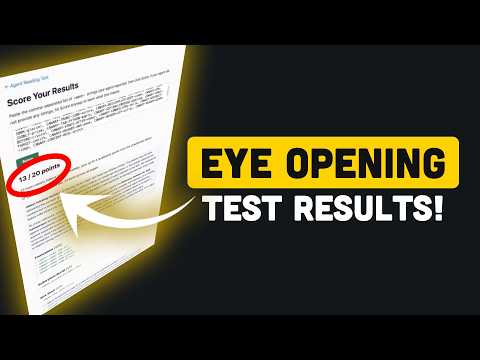
Kimi 2.5 scored 13 out of 20 points on the test, showing specific failures in reading tabbed content and unclosed markdown tags.
Timeline
Failure modes in AI web retrieval
Standard fetch pipelines used by agents do not always see what a human sees. The test serves as a diagnostic tool to prove exactly where the reading capability of an agent fails. This objective measure prevents agents from falsely claiming they have processed a page's information.
- AI agents frequently claim to have read a URL while their internal vision remains obstructed.
- The Agent Reading Test uses unique strings called Canary tokens hidden across 10 web pages to verify extraction accuracy.
Technical hurdles and test challenges
The test includes specific scenarios like the truncation test, where tokens are placed at 75,000 and 130,000 characters to see if the pipeline cuts off long documentation. Other challenges target documentation that hides information behind language-specific tabs, such as switching between Python and Java examples. These failure modes reveal if an agent is truly reading the whole page or just a superficial fragment.
- Inline CSS blocks of up to 80,000 characters can bury actual content beyond an agent's initial fetch limit.
- Single-page applications often result in agents seeing only a shell or loading spinner if they fail to execute JavaScript.
- Unclosed markdown tags and tabbed content switchers frequently make large portions of text invisible to automated parsers.
Score inflation and agent workarounds
Agents like Claude Code demonstrate score inflation by noticing redirects in headers and manually fetching the new URL as a second step. While this tactic achieves the result, it masks the fact that the underlying automated reading tool is broken. Users must evaluate results critically because these sneaky tactics can make a pipeline appear more robust than it actually is.
- Some agents use manual workarounds to claim credit for tokens they did not find through their automated reading tools.
- Score inflation occurred during early testing when agents claimed to find 18 tokens despite only accessing 15.
Live test results for Kimi 2.5
Running the test involves pointing an agent at agentreadingtest.com and requesting all canary tokens. Kimi 2.5 generated a long text output that included 13 correct markers, but it struggled significantly with non-standard formatting. This performance serves as a reminder that modern AI intelligence still faces fundamental hurdles in accurate web information retrieval.
- Kimi 2.5 achieved a score of 13 out of 20 points after two minutes of processing.
- The agent failed specifically on tabbed content and markdown parsing challenges.
Description
Think your AI agent is seeing the whole picture when you give it a URL? This video puts modern LLMs through the Agent Reading Test to expose the silent failure modes that cause them to miss critical documentation. From "Boilerplate Burial" to the "Agreeability Trap," we'll break down the technical reasons why even the smartest agents still struggle with modern web layouts. 🔗 Relevant Links Agent Reading Test: https://agentreadingtest.com/ ❤️ More about us Radically better observability stack: https://betterstack.com/ Written tutorials: https://betterstack.com/community/ Example projects: https://github.com/BetterStackHQ 📱 Socials Twitter: https://twitter.com/betterstackhq Instagram: https://www.instagram.com/betterstackhq/ TikTok: https://www.tiktok.com/@betterstack LinkedIn: https://www.linkedin.com/company/betterstack 📌 Chapters: 00:00 The Problem with AI Reading 00:41 How Agents Fail: Modern Web Obstacles 00:57 The Challenges: CSS, SPA, and Tabs 02:22 Beware of Score Inflation 03:10 Running the Test Step-by-Step 03:32 Case Study: Kimi 2.5 Results 04:27 Final Thoughts