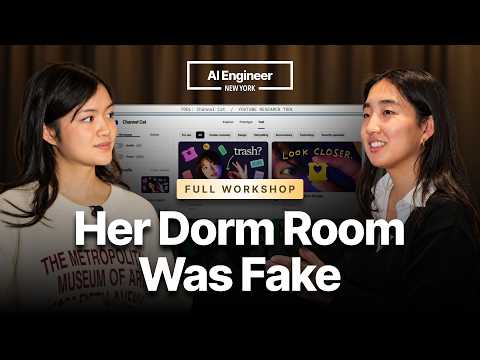
The AI Content System Behind 200M Views — Sarah Chieng, Cerebras & Cova Lee, OpenAI
Key Takeaway
Scaling video production relies on delegating repetitive tasks across ideation, editing, and distribution to specialized AI agents while directing creative taste through personal swipe files and real-world viewpoints.
Highlights
Visual aids increase human memory retention of information after three days from 10% to 65%.
Packaging accounts for roughly 50% of content performance on YouTube, making title and thumbnail generation worth half of the total production time.
Running models like GPT 5.6 Sol Ultrafast at 750 tokens per second accelerates script processing and multi-asset design iteration.
Autonomous video editing APIs like HeyGen's Hyperframes render completed videos directly from raw footage, documentation, and prompt constraints.
Astra and Model Context Protocol (MCP) integrations automate Premiere and Final Cut tasks including clip imports, sound placement, and 3D asset insertion.
Weekly automated process reviews detect operational bottlenecks like redundant file checks and unused notification channels.
Timeline
Production Framework and Inference Speed
Visual support anchors long-term audience recall. Systematizing creation into six sequential steps prevents bottlenecks across individual projects. Ultra-fast inference speeds allow complex scripts and multimodal prompts to evaluate instantly.
- Visual aids increase three-day information retention from 10% to 65%.
- A standard content system runs across six distinct stages: ideation, scripting, recording, editing, repurposing, and publishing.
- High-speed model execution at 750 tokens per second enables rapid iteration across extensive scripts and visual files.
Ideation Systems and Homepage Simulation
Swipe files built on Notion, Obsidian, or web scrapers ground AI tools in concrete creative tastes rather than generic prose. Custom agent tools scrape thousands of competitor assets to identify visual anomalies and test competitive positioning. Simulating YouTube homepage layout reveals whether a thumbnail commands attention before camera work begins.
- Centralized swipe files supply language models with taste benchmarks and creative references.
- Title and packaging design account for 50% of video success and warrant half of all creative time.
- Custom homepage simulators test thumbnail contrast against competing uploads prior to filming.
Script Generation and Production Asset Lists
Speaking ideas out loud via voice interfaces forces educational clarity and strips out marketing jargon. Generating multiple ranked script drafts reveals optimal structural pacing before production. Converting text into an annotated shot list details exact A-roll, B-roll, and screen capture requirements. Continuous local screen recording software logs coding demos silently, preserving historical footage for immediate recall.
- Interactive voice interviews prevent stiff, promotional scripting.
- Script prompts generate three distinct variations scored for clarity and viewer retention.
- Annotated two-pass shot lists convert completed scripts into filming checklists and production cues.
- Local background recorders like Coast capture software demonstrations continuously for timeline insertion.
Screen Capture, Asset Tagging, and Design Systems
Lightweight screen-capture tools apply blurs, arrows, and crop annotations instantly. AI models parse unorganized directories of footage, automatically renaming assets and linking corresponding media tracks. Scanning a creator's historical video portfolio extracts consistent color palettes, typography, and motion rules into reusable Figma templates.
- CleanShot enables rapid annotation and redaction without launching full video suites.
- Language models systematically rename and bind raw clips to editing timelines.
- Past video catalogs translate directly into Figma design systems and style parameters.
Autonomous Editing and Environment Manipulation
Connecting editor documentation to model APIs enables direct video rendering from rough clips and text guidelines. Computer use agents operate complex software by generating 3D models in Blender, transferring them to After Effects, and compositing them automatically. Masking personal video frames with generative fill inserts dynamic studio elements without expensive physical stages. Brief AI avatars replace minor verbal errors seamlessly without full reshoots.
- API-driven video platforms like Hyperframes assemble cuts, motion graphics, and subtitles automatically.
- Astra computer use and Final Cut MCP integrations run multi-track timeline tasks from natural language.
- Custom sound pads bind effects like clicks and whooshes directly to transition markers.
- Generative fill upgrades minimal room setups into detailed studio backdrops.
Repurposing, Captioning, and Scheduled Distribution
Month-long interview productions provide modular sound bites for automated vertical video pipelines. Feeding style references and negative prompt constraints, such as known markers of AI writing, strips sterile phrasing from auto-generated captions. Programmatic distribution engines evaluate optimal publishing windows and submit drafts for human review.
- Single long-form recordings yield multiple vertical short-form derivatives.
- AI captioning prompts incorporate public anti-slop guidelines to eliminate generic phrasing.
- API automations schedule staggered multi-platform distribution and generate channel-tailored metadata.
Process Audits and Workflow Optimization
Running structured retrospectives detects inefficient tool chains, such as redundant file imports and neglected notification channels. Tracking individual engagement metrics against channel baselines isolates high-performing formats. Shifting manual tasks like caption correction and asset formatting to automated pipelines frees creators to focus on high-level direction and taste.
- Weekly automated workflow reviews identify recurring time sinks across software stacks.
- Outlier performance analysis adjusts editorial skills based on anomalous viewer engagement.
- Automated tools handle execution mechanics so creators retain primary control over original vision.
Technical Extensions and Audience Expansion
Connecting social platform APIs directly to language models enables continuous A/B testing of hooks across identical video cuts. High-performing concepts emerge outside technical silos by translating distinct personal interests into approachable visual metaphors. Developer education increasingly addresses non-technical professionals operating software tools across AI-driven workplaces.
- Direct social API connections feed live engagement data into automated caption experiments.
- Real-world experiences and cross-domain hobbies generate authentic creative viewpoints.
- Technical content targets an expanding base of non-technical operators within AI ecosystems.
Description
Sarah Chieng (head of developer experience at Cerebras) and Cova Lee (OpenAI developer experience, formerly a full-time creator) share the agent-powered system they use to make content. It runs across six stages: ideating, scripting, recording, editing, repurposing and publishing. Topics include swipe files and custom research tools, voice-based scripting and script skills, shot lists, design systems, and editing through APIs and computer use. They also cover cutting long videos into shorts, scheduled publishing, and a weekly skill that reviews your own process. Their main point: let AI take the tedious work so you can treat content as a craft, not make slop. Chapters: - 00:00 Intro - 01:12 Meet Sarah and Cova - 04:05 The six stages - 05:19 Ideation: swipe files and research tools - 09:34 Scripting with your voice - 12:35 Shot lists and recording - 17:06 Design systems - 18:39 Editing with AI - 23:13 Transforming your visuals - 26:16 Repurposing and captions - 28:00 Publishing on autopilot - 29:25 Reviewing your own process - 32:02 Don't make slop - 34:19 Gear - 36:25 Q&A Sarah Chieng, Cerebras: https://www.cerebras.ai Cova Lee, OpenAI: https://openai.com Join us in SF for the second annual AIE CODE summit: https://aie.codes our last flagship summit of 2026. Applications live now!