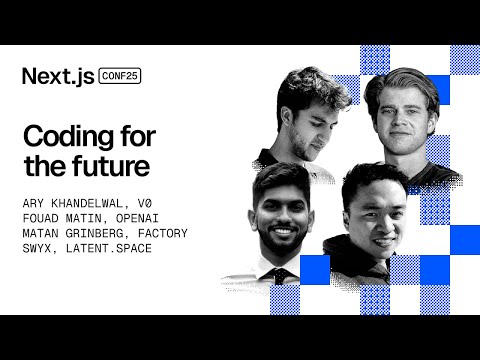
Coding for the Future Panel
핵심 요약
AI coding agents are rapidly evolving from experimental tools into mainstream productivity multipliers, with success determined by user skill, task clarity, and the emerging convergence of local and cloud capabilities.
하이라이트
AI coding agents enable developers to achieve 10x productivity multipliers, with the effectiveness varying based on user skill level and specificity of task definition
The debate between local versus cloud deployment is evolving toward convergence, with resource location and agent loop flexibility becoming key architectural considerations
Open-source models are gaining significant traction (projected to grow from 5% to 10-20% usage) as they approach frontier model capabilities while offering better cost efficiency and privacy benefits
Agent reliability and proactivity are expected to advance dramatically, with multi-hour, 100+ step workflows becoming standard within the next year
Successful agent usage requires specific task definition, clear output specifications, and proper delegation practices—treating agents as amplifiers of existing craft rather than magic solutions
The industry is moving toward agent-native development where junior engineers with strong delegation skills become arbiters between senior engineers' specifications and agent execution
Computer vision capabilities for AI agents remain an underdeveloped frontier that presents significant opportunity for future enhancement
타임라인
Introduction and Company Positioning
The panel introduces three major players in AI coding: Factory (focusing on end-to-end software development agents called 'droids'), OpenAI (developing Codex CLI and cloud solutions), and Vercel (building V0 for preview-driven agentic programming). Each organization explains their strategic approach to bringing AI capabilities into the software development lifecycle. Factory emphasizes handling not just coding but documentation, testing, and review. OpenAI highlights the integration of reasoning models with sandboxing primitives. Vercel describes V0's goal of enabling developers to prompt directly against running applications, representing the future of developer experience.
Local vs. Cloud Deployment Strategy
The panelists discuss the strategic differences between local and cloud agent deployment, with Factory starting local, OpenAI moving from cloud to local, and V0 being cloud-only. They reach consensus that the choice depends on resource location—local for file systems, cloud for remote repositories like GitHub. The fundamental insight is that humans work flexibly across both environments, so agents should similarly converge toward supporting both seamlessly. Factory notes that remote is better for smaller, well-defined tasks, while local suits larger or more complex tasks requiring close monitoring. Vercel adds that agent loops, tool calls, and resources must be independently flexible, with resource availability determining the optimal execution location rather than fixed architectural choices.
Quality, Leverage, and the 'Slop' Question
The panel addresses concerns about whether AI agents generate low-quality 'slop' or provide genuine value. The consensus is that perceived sloppiness depends on guidance quality and task specificity—generic prompts produce generic results, while detailed specifications with test verification yield structured output. Matan uses a documentation example, noting that auto-generated docs for legacy code, while imperfect, provide more value than no documentation. The broader insight is that agents operate as leverage tools: a principal engineer can produce 50,000 lines of code daily with agents versus 5,000 manually, maintaining quality proportional to input specification. V0 emphasizes that agents amplify existing craft skills—they raise the floor for beginners but don't guarantee quality without proper guidance and verification mechanisms.
Enterprise Adoption Patterns and Delegation Skills
Factory reveals an interesting bimodality in enterprise adoption: junior developers are philosophically open to agent-native development but lack delegation experience, while senior engineers are excellent at specifying tasks but resistant to changing their workflow. Vercel observes that enterprises are successfully arbitraging this dynamic, with senior engineers writing detailed specifications as tickets, junior engineers handing them to agents for execution. This creates an unexpected organizational model where technical leadership becomes specification-writing work while implementation shifts to agent execution managed by mid-level engineers. The panel emphasizes that successful agent usage mirrors team management practices—clear specifications, well-defined outputs, and understanding what information agents need to succeed are critical factors.
Open Source Models: Rising Adoption and Strategic Use
The discussion pivots to open-source models, with projections suggesting usage will grow from approximately 5% (start of 2024) to 10-20% by year-end. Matan highlights that open-source models like Qwen performed surprisingly well on Factory's Terminal Bench benchmark, though all top frontier models remain US-based. OpenAI explains their balanced strategy: closed-source models for open-ended reasoning tasks with unclear goal functions, while open-source models excel in niche tasks with clear objectives where fine-tuning enables specialized performance. V0 reports successfully replacing closed-source components with fine-tuned open models in their pipeline over the past year. The panel identifies a critical threshold: as open models cross the 'good enough' line for most tasks, they become the default choice due to cost, privacy, control, and observability benefits, with frontier models reserved for genuinely complex reasoning.
Future Capabilities: Multi-Hour Tasks and Proactive Context Gathering
Panelists discuss their vision for the next year of AI agent development, focusing on two primary advancement areas. First, agent step complexity will scale from today's 5-20 reliable steps to 100+ steps with multi-hour execution windows maintaining over 90% success rates, enabling full workday-equivalent tasks. Second, context gathering will shift from manual specification to proactive agent behavior—agents will automatically identify and fetch necessary resources via MCP connections without requiring users to know which sources are relevant. OpenAI emphasizes the need for agents to evolve from task executors into collaborators and 'favorite coworkers,' handling not just coding but also architecture, debugging, documentation, and persuasion. The panel agrees that the reliability and proactivity slider will continue advancing, though user behavior and environment setup significantly influence achievable performance levels.
Closing Remarks and Computer Vision Opportunities
The moderator closes with remarks emphasizing that agents can accomplish virtually everything today, but reliability and proactivity remain the key advancement vectors. The discussion acknowledges that agent effectiveness depends on both technological capabilities and user adaptation—proper environment setup and behavioral alignment with agent constraints yield significantly higher performance. The moderator highlights computer vision as an underdeveloped frontier, encouraging the audience to explore CV use cases with Atlas. The panel thanks the audience as the session concludes with applause, leaving the impression that practical, real-world agent deployment is rapidly maturing while future advances will focus on reliability, autonomy, and capability expansion.
설명
Explore how AI coding tools like Codex, v0, and Factory are transforming the way developers build and innovate with Next.js and for the web. Get a demo today: https://vercel.com/contact/sales/demo