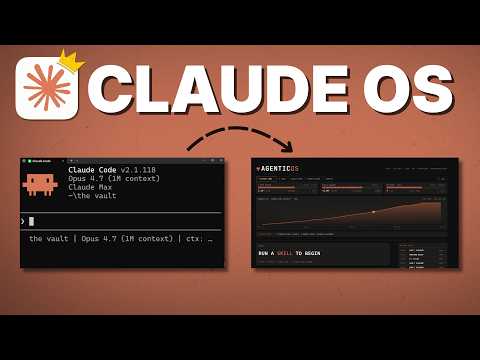
Claude Code Agentic OS = UNSTOPPABLE
핵심 요약
Building an agentic OS around Claude Code, powered by Obsidian for memory and custom dashboards for accessibility, enables non-technical teams to execute complex, consistent AI workflows.
하이라이트
An agentic OS using Claude Code solves the three primary barriers to adoption: memory gaps, task consistency, and intimidating terminal interfaces.
Obsidian serves as a cost-free, highly customizable memory store, eliminating the need for complex RAG architectures.
Categorizing workflows into an organizational chart—such as research, sales, and marketing—allows Claude Code to execute specific tasks with predictable outcomes.
Remote automation via GitHub enables scheduled tasks to run without requiring the user's computer to be powered on.
Non-technical team members can execute advanced AI workflows via a command center dashboard, extracting 90% of Claude Code's power without ever opening a terminal.
Mac Minis provide a robust local environment for workflows requiring direct access to local files or specific CLI tools, avoiding the constraints of cloud-only execution.
타임라인
The Agentic OS Architecture
Claude Code functions as the engine, but it lacks inherent memory and accessibility for non-technical users. An agentic OS addresses this by organizing skills and automations into a structured framework that mimics an organizational chart. This structure ensures that tasks are executed in a specific way to achieve repeatable outcomes.
- Advanced coding tools require a holistic architecture to bridge the gap between AI capability and user proficiency.
- The three core problems for users are memory, consistency, and terminal interface intimidation.
Implementing Memory and Consistency
Users do not need full-blown agentic RAG systems; folders in Obsidian provide sufficient, free, and customizable memory. By organizing these skills into hierarchical branches—like a company org chart—users create a mental model that is both intuitive for humans and clear for Claude Code to execute.
- Obsidian functions as a simple, effective memory store that avoids the complexity of traditional RAG systems.
- Consistency is achieved by mapping specific business functions, such as sales or research, to dedicated skill sets.
Accessibility Through Command Centers
Terminal interfaces are intimidating for 99.9% of users. Wrapping complex CLI-based AI skills into simple dashboard buttons makes the technology accessible to non-technical team members and clients, effectively marketing the power of the system by hiding the 'black box' of the terminal.
- Command center dashboards allow non-technical users to utilize Claude Code without interacting with the terminal.
- Visualizing AI workflows as buttons on a dashboard significantly increases the value proposition for potential clients.
Skill Execution and Automations
The Skill Creator skill allows users to define, test, and optimize tasks for quantifiable results. Choosing between local and remote automation depends on whether the task needs to interact with the user's specific local environment or if it can run independently in the cloud while the user's computer is off.
- Skills should directly reflect day-to-day tasks within an actual workflow.
- Local automation is necessary for tasks interacting with local CLIs or files, while remote automation is ideal for native, cloud-based tasks.
The Dashboard as a Visual Link
The command center acts as the visual interface for all skills and automations, displaying usage rates and recent runs. While proficient users who live in the terminal may find the framework unnecessary for personal use, it remains a high-value tool for standardizing operations across a business or team.
- Dashboards enable headless execution of skills, providing immediate results and updates to the local Vault.
- Advanced users may not need the framework to understand how the system works, but it remains critical for scaling to teams and clients.
설명
⚡Master Claude Code, Build Your Agency, Land Your First Client⚡ https://www.skool.com/chase-ai 🔥FREE community with the prompts🔥 https://www.skool.com/chase-ai-community 💻 Need custom work? Book a consult 💻 https://chaseai.io Claude Code Agentic OS is the future/ In this video I break down the four layers that make up a complete Agentic OS (memory, skill fleet, automations, and a dashboard), the three gaps in normal Claude Code usage that this architecture solves (memory, consistency, and an intimidating terminal interface), and the general principles for building one yourself. ⏰TIMESTAMPS: 0:00 - Intro 0:46 - Agentic OS Overview 6:35 - Memory + Consistency 14:06 - Dashboard 16:11 - Advanced Users 18:48 - Final Thoughts RESOURCES FROM THIS VIDEO: ➡️ Master Claude Code: https://www.skool.com/chase-ai ➡️ My Website: https://www.chaseai.io #claudecode