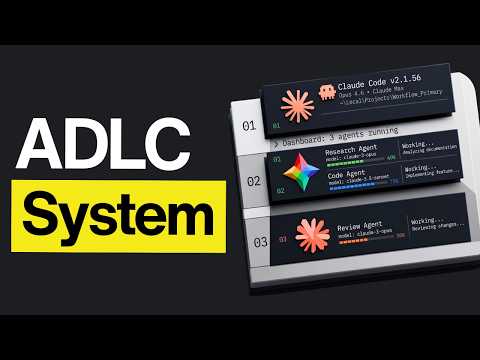
ADLC: Claude Code's New Lifecycle for AI Coding
Key Takeaway
The Agentic Development Lifecycle (ADLC) provides a 7-phase framework designed to manage the probabilistic behavior, continuous learning, and human-accountability structures required by AI agents in production.
Highlights
The Agentic Development Lifecycle (ADLC) replaces the traditional Software Development Lifecycle (SDLC) to handle the non-determinism of AI agents in production.
ADLC shifts success metrics from binary pass/fail functional correctness to accuracy distribution, hallucination rate, and cost per outcome.
Logic in ADLC expands beyond code, configuration, and dependencies to spread across code, prompts, models, tools, and external services.
Context management remains critical even with 1 million token windows in Gemini and Opus to prevent context rot and degraded attention.
Deployment in ADLC marks the beginning of active monitoring for model updates, context drift, and environmental changes rather than the end of development.
Timeline
The Shift from SDLC to ADLC
Software development frameworks require a shift because systems built today do not behave like old software. Before AI, development relied on repetitive coding and merging snippets to achieve predictable behavior verified during planning. Because AI agents reason and adapt to environments dynamically, traditional metrics cannot accurately grade their output.
- Traditional software development lifecycles fail when applied to unpredictable, evolving AI agent systems.
- SDLC treats software as a static piece with predictable inputs and outputs, while ADLC treats it as a living, probabilistic system.
- Decisions in agentic workflows depend heavily on the prompt, context, models, and connected external tools.
Phase 1: Preparation and Hypothesis
Planning remains the first step for both traditional and agentic systems, but the methodology changes. Teams must coordinate with stakeholders to review existing policies and pinpoint exactly where workflows break down or require repeated manual effort. Because AI involvement makes outcomes probabilistic, developers must force the model to outline behavioral assumptions before architecture planning begins.
- The first phase of ADLC builds a grounded understanding of the problem before committing to system design or specific models.
- AI planning modes must map out workflow behavior, user interactions, and potential overhead instead of implementation code.
- Skipping the preparation phase leads to automating the wrong manual workflows and worsens existing system issues.
Phase 2: Scope Identification and Feasibility
This phase maps directly to the analysis phase or feasibility study of traditional SDLC. Key performance indicators established here include time, cost, latency, and overall feasibility. Defining the boundaries of autonomy ensures regulatory compliance and forces the AI planning mode to account for latency and systemic failure risks during the early iteration cycle.
- Phase two maps out business and technical KPIs upfront alongside clear constraints and technical boundaries.
- The human-agent responsibility model creates an accountability structure ensuring humans review critical agent decisions.
- Explicitly defining trade-offs prevents entire blame from shifting to the model during an operational failure.
Phase 3: Architecture and System Design
Designing agentic architecture requires planning data flows meticulously from one point to another, which becomes highly critical in multi-agent environments to prevent corrupted inputs. This phase marks the selection of specific models, orchestration frameworks, and databases. Potential trade-offs regarding latency, accuracy, and hallucinations are completely analyzed before any functional code is written.
- System design defines the specific pattern the agent follows, such as react, plan-and-act, or multi-agent configurations.
- Cost structures must incorporate token economics, context editing features, compaction, and multi-user scaling predictions.
- Success definitions established during design allow developers to build the agent using Test-Driven Development (TDD).
Phase 4: Simulation and Proof of Value
This phase acts as a strict validation gate where prototypes face behavioral testing against collected datasets. Key metrics analyzed include data quality, hallucination rates, accuracy, response quality, and established benchmarks. If a prototype fails to demonstrate a return on investment at this stage, the project is terminated before entering costly production environments.
- Simulation utilizes real-world data to test high-risk assumptions and determine if development should proceed.
- The primary output of this phase is a ground truth document used for regression testing and model fine-tuning.
- Validating performance early drastically lowers the overall financial and operational cost of failure.
Phase 5: Implementation and Context Management
Implementation clearly splits from SDLC because logic no longer lives solely in code and configurations. Developers integrate tools like Model Context Protocol (MCP) and APIs for services like Google Calendar, Gmail, and Notion. Development and validation happen side by side, demanding constant manual testing because a minor prompt adjustment can completely alter the final output workflow.
- Agentic logic spreads dynamically across code, prompts, models, tools, and external services.
- The agent view in Claude Code provides a single orchestration layer to manage and delegate tasks to multiple agents.
- Context windows require careful handling to prevent context rot and widespread attention degradation.
Phase 6: Integrated Testing and Evaluation Frameworks
Testing paradigms shift away from traditional predefined tests that validate known code paths. User acceptance testing gathers direct feedback from real users to identify edge cases, while secondary testing addresses bias, compliance, and risk dimensions. Teams execute functional, non-functional, structural, and load tests, frequently utilizing secondary agentic systems to run the evaluations.
- Testing occurs under full production conditions rather than evaluating isolated, individual software components.
- Continuous evaluation tracks reasoning, safety, and tool usage because agents rarely execute the exact same path twice.
- Frameworks like RAGAS and DEEPVAL verify system correctness against historical behavioral metrics.
Phase 7: Deployment, Monitoring, and Continuous Learning
In ADLC, deployment is not the end of development but a controlled activation characterized by limited canary rollouts to specific user groups. Ongoing maintenance relies on explicit user interface signals like thumbs up, thumbs down, or response ranking to capture sentiment. Systems require periodic updates to data sources, embeddings, and prompt-injection guardrails to manage long-term costs and maintain alignment.
- Deployment initiates active monitoring and control against model updates, context drift, and environmental shifts.
- Alerting rules must actively track behavioral performance, safety, and quality metrics to catch large-scale errors early.
- Negative signals and user interface feedback loops continuously refine the agent model post-launch.
Description
Build and launch your full-stack app with AI today, grab your free credits here: https://softr.io/build-with/ai-labs?utm_source=faizan&utm_medium=influencer&utm_campaign=ai_co-builder&utm_content=ailabs_march_launch_yt_integration AI agents do not fit the old SDLC, and ai coding teams are paying the price. An ai coding assistant behaves differently than traditional software, so vibe coding and modern ai programming need a lifecycle built for non-determinism, context drift, and continuous evaluation. Community with All Resources 📦: http://ailabspro.io We're building The Roundup — a daily newsletter covering the AI stories that actually matter. Join now at: https://www.theroundup.so/ In this video, we walk you through the Agentic Development Lifecycle, the framework that replaces the old SDLC for teams doing ai coding with agentic systems. Traditional software was predictable, but coding with ai changed everything, because the same prompt can return different outputs, and you cannot grade an agent the way you grade static software. We break down all seven phases of ADLC, from planning and analysis to design, validation, implementation, testing, deployment, and maintenance. Whether you are doing vibe coding ai prototypes in Claude Code or shipping production agents, this lifecycle gives you the structure most coding ai projects skip entirely. You will learn why the best coding ai workflows always start in planning mode, how to map the human and agent responsibility model, and why ai for coding now means continuous evaluation instead of pass or fail testing. We also cover claude ai coding tradeoffs like context management, model selection, cost economics, and how to avoid context rot when working with large context windows. This is an easy ai coding guide for anyone who has been jumping straight into building agents without a proper lifecycle. Once you adopt this framework, ai vibe coding stops feeling chaotic, and you start shipping ai agent systems that actually hold up in production. We also touch on the ai coding tools that fit into each phase, from the new Claude Code agents view for orchestration to MCP integrations for tool access, plus feedback signals seen in production tools like Claude and ChatGPT. If you are serious about ai agents, claude code, or any modern vibe coding stack, this lifecycle is the difference between a prototype that breaks and a system that scales. 0:00 Intro 0:32 What SDLC is and why it broke 1:25 Why ADLC was needed 2:29 The 7 phases of ADLC 2:36 Phase 1: Preparation and hypothesis 4:10 Phase 2: Scope and problem identification 5:38 Phase 3: Design and architecture 6:51 Phase 4: Simulation and proof of value 8:02 Sponsor 8:58 Phase 5: Implementation 11:02 Phase 6: Testing 12:34 Phase 7: Deployment 13:53 Maintenance and continuous learning Hashtags: #claude #claudecode #ai #chatgpt #vibecoding #aiagent #aiagents #aicoding