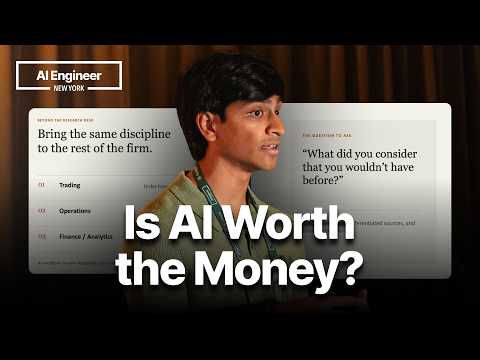
Proving Alpha: How a Hedge Fund Measures AI's ROI - Hari Kumar, Contour Asset Management
Key Takeaway
Measuring artificial intelligence return on investment in fundamental hedge funds requires tracking process changes, analyst time allocation, and cost per useful insight rather than expecting immediate profit and loss impact.
Highlights
Contour Asset Management is a fundamental long-short hedge fund managing six billion dollars in assets with approximately fifteen to twenty people.
The firm utilizes live A/B tests to compare analyst research workflows with and without artificial intelligence tools.
Manual idea generation agents combine alternative data sets like credit card panels and expert interview transcripts to refine investment theses.
Tracking metrics such as time spent per name and cost per useful insight helps measure the operational impact of technology investments.
Internal platforms integrate fragmented operations, compliance, and order-keeping workflows into a single system.
Timeline
Establishing AI Impact in a Fundamental Hedge Fund
Operating as a fundamental long-short shop with six billion dollars in assets, the firm explores ways to shake up traditional workflows. Introducing artificial intelligence across all operational areas requires proving concrete impact on both investment ideas and operational efficiency.
- Contour Asset Management focuses primarily on the technology, media, and telecommunications space.
- Integrating artificial intelligence into research, trading, operations, compliance, and finance creates significant measurement challenges.
- Connecting technology spend to tangible gains remains difficult for fundamental investment firms.
Conducting Live A/B Tests for Research Workflows
The firm implements controlled tests to determine whether analysts reach identical conclusions without artificial intelligence assistance. Documenting the research path from initial data gathering to final thesis validation reveals how agentic tools influence decision-making speed and idea quality.
- Ten analysts cover between thirty and forty names each, maintaining structured three-month earnings cycles.
- Live A/B tests record processes without large language models and compare them against agentic workflows.
- Agent-run expert calls and automated note synthesis alter how analysts reach final investment conclusions.
Automating Idea Generation and Timing Tracking
Investment ideas often stall when portfolio managers prioritize other assets, leading to missed market windows. Automated agents continuously monitor past notes against current market conditions, surfacing actionable opportunities when timing aligns while combining disparate datasets into a cohesive platform.
- Manual idea generation agents layer alternative data points and expert insights onto analyst theses.
- Background tracking agents monitor shelved ideas against market movements to alert portfolio managers and traders of optimal entry windows.
- API access and Model Context Protocol integrations merge isolated alternative data sources like credit card panel data into unified agent workflows.
Quantifying Analyst Time and Operational Efficiency
Fundamental investing yields profit and loss outcomes over months rather than days, making immediate financial attribution difficult. Monitoring daily analyst time allocation alongside generated insights clarifies whether technology investments genuinely improve workflows or merely add administrative friction.
- Tracking daily time spent per name connects research hours directly to eventual profit and loss outcomes.
- The firm evaluates technology efficiency using a proprietary metric called cost per useful insight.
- Consolidating fragmented order management, compliance, and Bloomberg workflows into single platforms reduces repetitive tasks.
Up-Leveling Data Subscriptions and Managing Technical Debt
Integrating third-party financial data providers into internal systems allows tools to learn continuously from analyst habits. Factoring in the technical downtime required to maintain custom model connectors ensures realistic assessments of artificial intelligence productivity gains.
- In-house platforms ingest external subscription data from providers like Alphasense and customize it to individual analyst model patterns.
- Technical maintenance hours spent fixing broken model calls and API connectors form part of the overall return on investment equation.
- Unified agent layers across multiple tasks provide long-term competitive advantages for smaller fundamental shops.
Description
Hari Kumar, head of AI at Contour Asset Management, a $6B fundamental long/short fund focused on tech, media and telecom, tackles the hardest question in AI adoption: what are we actually getting for the spend? He shares how Contour runs live A/B tests of analysts' research with and without AI tools, tracks "cost per useful insight," uses agents to resurface old ideas when the market makes them interesting again, and extends the same thinking to trading, ops and compliance. Chapters 00:00 Intro: AI at a $6B fundamental fund 01:45 Why AI ROI is so hard to capture 02:25 Live A/B tests of research with and without AI 05:42 Measuring the process, not just P&L 06:24 Idea generation and timing agents 08:57 Bringing alternative data together 10:04 Time spent and cost per useful insight 11:44 AI across trading, ops and compliance 14:35 Getting more from existing data spend 16:40 The hidden cost of fixing AI tools Hari Kumar, Contour Asset Management Join us in SF for the second annual AIE CODE summit: https://aie.codes our last flagship summit of 2026. Applications live now!