Vite, Rust & The Future of JavaScript Tooling | Better Stack Podcast Ep. 11
Key Takeaway
Evan You and the VoidZero team are revolutionizing the JavaScript ecosystem by building a unified, Rust-based toolchain designed for extreme performance, AI integration, and a seamless developer experience.
Highlights
Evan You introduces VoidZero and its mission to build a high-performance, vertical Rust-based toolchain for JavaScript.
The development of Rolldown aims to provide a unified, blazing-fast bundler that resolves inconsistencies between development and production builds.
OXC serves as a low-level suite of tools, featuring a parser that is significantly faster than existing alternatives like SWC.
Vite+ is evolving into an opinionated, zero-config entry point that simplifies environment management, linting, and formatting for developers.
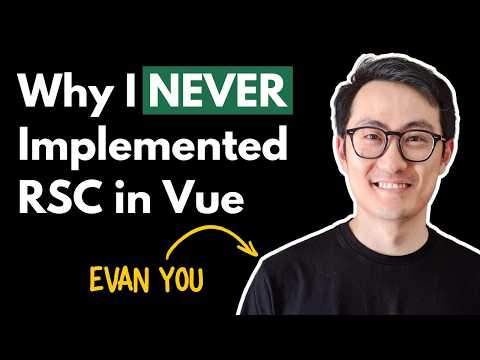
Evan expresses skepticism regarding React Server Components (RSC), citing concerns over DX complexity and the necessity of server-side compute.
The team is heavily leveraging AI to accelerate development, including experimental ports of compilers from TypeScript to Rust.
Performance benchmarks show OXLint and OXFormat outperforming ESLint and Prettier by factors of up to 100x.
Timeline
Introduction to VoidZero and New Rust Tooling
Evan You introduces his new company, VoidZero, which focuses on developing next-generation open-source tools for the JavaScript ecosystem. He highlights projects like Rolldown, a Rust-based bundler, and OXC, a high-performance toolchain that includes a parser, resolver, and transformer. The team consists of elite engineers who are increasingly using AI to accelerate the development of these low-level tools. Evan explains that his role has shifted toward high-level DX decisions and product strategy rather than writing daily code. This section establishes the vision of creating a faster, more cohesive vertical stack for developers.
The Evolution of Vite and the Need for Rolldown
The discussion pivots to the history of Vite and why the current architecture—which combines esbuild and Rollup—needs to evolve. Evan explains that while esbuild is fast, it lacks the flexibility for complex chunk splitting and plugin extensibility required for production. Conversely, Rollup is highly flexible but limited by the single-threaded nature of JavaScript, making production builds relatively slow. Mixing a Rust parser into a JS-based system often fails to improve speed due to the high cost of data passing between languages. Therefore, the team decided to build Rolldown as a dedicated Rust port of Rollup to achieve the best of both worlds.
OXC: The High-Performance Foundation
Evan delves into the technical specifics of OXC and its role as the foundation for the entire VoidZero stack. He highlights how OXC uses an arena allocator to manage memory more efficiently, resulting in a parser that is three times faster than SWC. The project aims to eliminate the friction of configuring separate tools like ESLint, Prettier, and Jest by providing a unified configuration. Benchmarks show that OXLint is 50-100 times faster than ESLint, while OXFormat is significantly faster than Prettier. This vertical integration ensures that the linter, formatter, and bundler all share the same logic, preventing common configuration surprises.
The Future of Bundling vs. Unbundled Approaches
Responding to questions about Rails and import maps, Evan explains why bundlers remain essential despite the 'no-build' movement. While unbundled native ESM works well for small apps, it faces severe bottlenecks at the network level when dealing with thousands of modules due to waterfall requests. Bundling remains a 'free optimization' that significantly improves user experience on slower networks by reducing round trips. Evan acknowledges the community's resentment toward complex configurations but argues that the solution is better tooling rather than abandoning builds entirely. He emphasizes that large-scale enterprise applications cannot effectively operate in a purely unbundled state without sacrificing performance.
Vite+ and the Onboarding Experience
Evan clarifies the vision for Vite+, describing it as an opinionated starting point that simplifies the entire JavaScript development lifecycle. It acts as a replacement for version managers like NVM and package manager orchestrators like Corepack, automatically handling the environment setup. The goal is to allow a new developer to go from a fresh machine to a running app with a single command without worrying about Node versions or config files. Evan also discusses the business model, noting that the licensing threshold will be high to ensure most users can enjoy it for free. He touches on the role of AI, explaining how tools must provide better guardrails to prevent AI agents from accumulating technical debt.
Rust Choice, AI Integration, and Model Capabilities
The conversation explores why the team chose Rust over Go, noting Rust's superior WebAssembly support and the availability of composable crates like OXC. Evan reveals that the team is 'AI-pilled,' using agents to perform massive experimental tasks like porting the Angular compiler to Rust. He notes that while he was initially a skeptic, the rapid improvement in models like Claude 3.5 and the use of 'plan mode' have significantly boosted productivity. However, he maintains that human steering remains critical, as AI still requires experts to provide the right prompts and architectural oversight. This section highlights the intersection of low-level systems programming and modern AI-driven development workflows.
Critique of React Server Components and Closing
In the final segment, Evan shares his skepticism regarding React Server Components (RSC), describing them as highly complex and not a universal 'silver bullet.' He criticizes the DX paper cuts, such as the confusion between 'use server' and 'use client' directives, and the heavy reliance on specific frameworks like Next.js. Evan argues that the benefits of reduced bundle size are often offset by increased server load and the loss of offline-first capabilities. Regarding Vue's ecosystem, he notes that Vercel's acquisition of Nuxt Labs has been relatively hands-off and hasn't negatively impacted the community. The podcast concludes with Evan departing for a call, followed by closing remarks from the hosts.
Description
In this episode, Evan You, creator of Vue.js and Vite, shares his journey from building Vite to founding VoidZero and developing a complete Rust-based JavaScript toolchain. He discusses the evolution from Vite's ESBuild+Rollup hybrid to Rolldown, the 50-100x performance gains with OXC (linter, formatter, parser), and how Vite Plus aims to simplify the entire JavaScript onboarding experience. Evan also shares his thoughts on the future of bundling vs no-build approaches, why his team chose Rust over Go, how they're using AI to ship features faster while maintaining code quality, and offers a candid take on React Server Components as a long-time skeptic who believes the trade-offs often outweigh the benefits. 🔗 Relevant Links Do we need bundlers - https://rolldown.rs/in-depth/why-bundlers ❤️ More about us Radically better observability stack: https://betterstack.com/ Written tutorials: https://betterstack.com/community/ Example projects: https://github.com/BetterStackHQ 📱 Socials Twitter: https://twitter.com/betterstackhq Instagram: https://www.instagram.com/betterstackhq/ TikTok: https://www.tiktok.com/@betterstack LinkedIn: https://www.linkedin.com/company/betterstack 📌 Chapters: