Kimi K2.5 Review: The Era of 100 Agents Writing Code
 makedream
1. Februar 2026
0
Computing/Software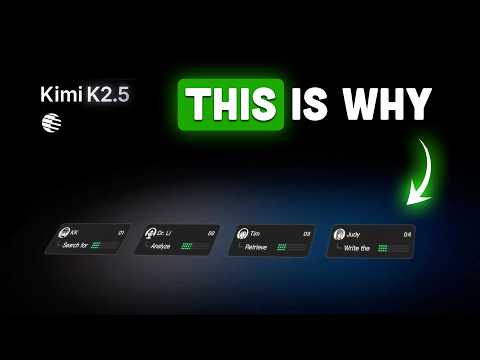
Comments (0)
Log in to leave a comment
No posts yet
makedreamLog in to leave a comment
No posts yet
The era of simply "smart" chatbots is over. Now, systems that actually get work done are taking the lead. Moonshot AI's newly released Kimi K2.5 stands at the pinnacle of this shift. This monstrous model, boasting 1.04 trillion parameters, has moved beyond merely generating text. It can analyze a video and instantly output complex web UI code. Let's dive into why it's being hailed by developers as the "final boss" of Vision-to-Code.
At the heart of Kimi K2.5 is the Agent Swarm architecture. Instead of a single genius handling everything, up to 100 sub-agents simultaneously perform their assigned roles.
Conventional AIs often suffer from "serial collapse," where an error in the first step causes all subsequent tasks to fail. Kimi K2.5 solves this through Parallel Agent Reinforcement Learning (PARL).
Despite being a 1.04T model, it maintains efficiency by using only 32 billion parameters during actual inference. It's like a high-performance sports car that saves fuel by only running the necessary engines.
Kimi K2.5's true prowess shines when interpreting visual data. It doesn't just look at still images; it can implement code with live interactions just by watching a video of a user scrolling or clicking through a website.
In actual testing, we fed it a video of a complex Apple-style UI. The results were stunning. It perfectly recreated parallax scrolling and subtle fade-in effects using CSS animations. It even captured pixel-level margins and shadow depths. This is the moment where the repetitive labor of translating a designer's mockup into code disappears.
When you enable Agent Swarm mode, you can see in real-time which module each agent is modifying. Watching a digital team move busily inside your screen is quite an enjoyable experience. A major advantage is being able to visually confirm progress rather than waiting blindly for the task to finish.
While the technical achievements are brilliant, blind faith is ill-advised. Kimi K2.5 also carries significant weaknesses.
The Wall of Data Hallucination
When requesting the latest information, it frequently presents past data as if it were current fact. The hallucination rate is measured between approximately 69% and 74%. This is considerably higher than the 26% shown by its competitor, Claude 4.5. It is better suited for frontend tasks where visual implementation is key, rather than backend logic where logical precision is vital.
The Benchmark Trap
There is controversy regarding contamination, suggesting that evaluation questions may have been included in the training dataset. This means the performance felt in the field might be lower than the publicly released scores.
Kimi K2.5 is not just a worker for writing boilerplate code; it is an orchestra following your baton. There is no more powerful tool for prototyping stages where visual implementation is urgent.
To use this model successfully, you should adopt a hybrid strategy. Entrust sophisticated logic design to Claude, while utilizing Kimi for large-scale design-to-code conversions or video-based research. Always verify the agents' output with a manual checklist. Simply by installing Moonshot AI's CLI tools and uploading screen recordings of existing sites, your workflow will change completely.